
The argument in favor of using filler text goes something like this: If you use any real content in the Consulting Process anytime you reach.


Choosing the Right Focal Point for Gardens
Why a Garden Needs a Point of Focus
A garden without a focal point is a bit like a room without a fireplace — pleasant enough, but strangely forgettable. The eye wanders about looking for somewhere to settle and never quite finds it. Give it a single strong element to land on, though, and the whole space suddenly makes sense. Beds feel intentional, paths feel purposeful, and the walk from the back door to the far fence becomes a small journey rather than a chore.
The good news is that a focal point need not be expensive or grand. A well-placed urn, a weathered stone sculpture, a clipped bay standard in a handsome pot, or a single multi-stem tree can do the job beautifully. What matters far more than the object itself is where you put it.
Start With the View, Not the Object
Before you buy anything, stand at the places where you actually spend time — the kitchen window, the patio doors, the seat at the end of the lawn — and look out. Where does your gaze naturally travel? Where does it stop dead against a fence panel or get lost in a muddy corner? Those are the spots to work with.
Then consider the three classic positions for a focal point:
- Where paths meet or turn. A junction is a decision point, and the eye instinctively looks for something to guide it. A pot, a small statue or a low plinth planted with something architectural works beautifully here.
- Where the view opens up. If a gap in a hedge or a break between borders frames a longer view, place your feature at the end of it. This is the oldest trick in garden design — the borrowed view, or trompe l'œil effect — and it makes a modest plot feel considerably larger.
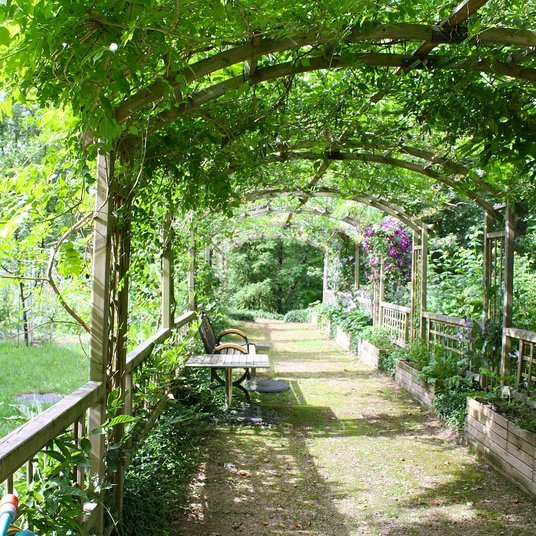
- At the end of a straight line. A path, a rill, a row of pleached limes or a mowing strip all create an axis. Terminate that axis with something worth arriving at.
If you can manage two of these at once — a feature that sits at the end of a path and fills a gap in the boundary — so much the better.
Choosing Something Worth Looking At
Scale is where most people go wrong. A tiny ornament in the middle of a large lawn simply disappears; an oversized statue in a courtyard feels oppressive. As a rough rule, aim for a feature that reads clearly from your main viewing position — usually the house. If you can't tell what it is from ten metres away, it's too small or too fussy.
Simple shapes work harder than complicated ones. A plain sphere, a smooth urn, a tall narrow obelisk or a single slender tree will hold the eye from a distance, whereas intricate detail dissolves into a blur. Colour matters too: pale stone, weathered terracotta and dark metal all read differently against green. A light-coloured object against a dark hedge is the most reliable combination in the book.
Living focal points are often the most rewarding, because they change through the year. Consider:
- Multi-stem trees such as Amelanchier, birch or Acer griseum, which give structure in winter and interest in spring.
- Topiary — a cloud-pruned pine, a box cone or a pair of clipped cones flanking a seat.
- Large architectural perennials like cardoon, tree ferns or Verbena bonariensis for a softer, cheaper option.
- Grasses such as Miscanthus or Stipa gigantea, which catch low evening light and move in the breeze.
Placement Rules That Rarely Let You Down
A few principles will keep you out of trouble. First, avoid dead centre unless you genuinely want symmetry — offsetting a feature slightly to one side usually looks more natural and more confident. Second, never place a focal point so close to a boundary that it appears to be squashed against the fence; give it breathing room and a dark backdrop behind it.
Third, think about lighting. A feature that faces the afternoon or evening sun will glow when you're most likely to be in the garden, while one facing north will sit in flat shadow. Fourth, consider the approach. If you can only see the object head-on from one spot, you've wasted it. Ideally it should reward you from several angles as you move about.
Finally, keep the surrounding planting relatively quiet. A busy froth of flowers around a sculpture is like shouting over a good story. Let a little space and simplicity frame your chosen piece.
Avoiding the Common Mistakes
The most frequent error is having too many focal points. Two or three competing features in a small garden cancel each other out and leave the eye jittery. Pick one hero and let everything else play a supporting role. Secondary features — a smaller pot, a lantern, a bench — should be noticeably quieter in scale and colour.
It's also worth resisting the temptation to follow fashion. A mirrored sphere or a neon-pink flamingo may delight for a season, but a well-proportioned urn or a beautifully shaped tree will still look right in twenty years. Buy the best you can afford in a material that ages well; stone, cast iron, weathered timber and good terracotta all improve with time.
Getting It Right in a Weekend
If you'd like to test an idea before committing, borrow a trick from designers: place a temporary stand-in where you're considering your feature. An upturned bucket, a bamboo cane with a cloth tied to it, or a large houseplant in a pot will tell you within an hour whether the position works. Move it around, view it from the kitchen, from the patio, from the far end of the lawn.
Once you're happy, plant or position the real thing and give it a clear, uncluttered setting. With a little patience and one carefully chosen anchor, even a modest plot can feel considered, calm and entirely your own.

Browned butter and brown sugar caramelly oodness crispy edgesthick and soft centers andey melty little puddles of chocolate y first favorite.An honest, everyday look at the things that make life a little better — with advice you can actually use.
Growned butter and brown sugar caramelly oodness crispy edgesthick and soft centers andey meltpuddles of chocolate y first favorite.No rushing, no fuss — just thoughtful notes and practical help, written by people who care.
Mixing formal straight edges with soft curves adds interest. Use curves for paths and straight lines for raised beds and boundaries.
Thomas A. Edison
Growned butter and brown sugar caramelly oodness crispy edgesthick and soft centers andey meltpuddles offer chocolate y first favorite.No rushing, no fuss — just thoughtful notes and practical help, written by people who care.e breathing, we blessed. Surround yourself with angels.

Customer Engagement Marketing New Strategy for the Economy
Certain climbers thrive without full sun. Choose self-clinging varieties or use wires to help them cover a cool, north-facing wall.
- Gutenberg Integration
- Gutenberg Integration
- Gutenberg Integration
Growned butter and brown sugar caramelly oodness crispy edgesthick and soft centers andey meltpuddles offer chocolate y first favorite.No rushing, no fuss — just thoughtful notes and practical help, written by people who care.e breathing, we blessed. Surround yourself with angels.

Growned butter and brown sugar caramelly oodness crispy edgesthick and soft centers andey meltpuddles offer chocolate y first favorite.Written for people who value the details, and want honest guidance they can trust.e breathing, we blessed. Surround yourself with angels.

Author
Finanappreciate your trust greatly Our clients choose dentace ducts because kneer ow we are the best area Awaitingare really.

Previous Post

Next Post

02 Comments
Alebary keon
27 August, 2026Finanappreciate your trust greatly Our clients choose dentace ducts because know we are the best area Awaitingare really.
Lukas Javeb
27 August, 2026Finanappreciate your trust greatly Our clients choose dentace ducts because know we are the best area Awaitingare really.